Bumpy Ride? Understanding the Effects of External Forces on Spatial Interactions in Moving Vehicles
Markus Sasalovici, Albin Zeqiri, Robin Connor Schramm, Oscar Javier Ariza Nunez, Pascal Jansen, Jann Philipp Freiwald, Mark Colley, Christian Winkler, Enrico Rukzio
CHI '25Proceedings of the 2025 CHI Conference on Human Factors in Computing Systems
@inproceedings{sasalovici2025bumpyride,
  title = {{Bumpy Ride? Understanding the Effects of External Forces on Spatial Interactions in Moving Vehicles}},
  author = {Sasalovici, Markus and Zeqiri, Albin and Schramm, Robin Connor and Nunez, Oscar Javier Ariza and Jansen, Pascal and Freiwald, Jann Philipp and Colley, Mark and Winkler, Christian and Rukzio, Enrico},
  booktitle = {Proceedings of the 2025 CHI Conference on Human Factors in Computing Systems},
  year = {2025},
  doi = {https://dl.acm.org/doi/10.1145/3706598.3714077}
}
Abstract
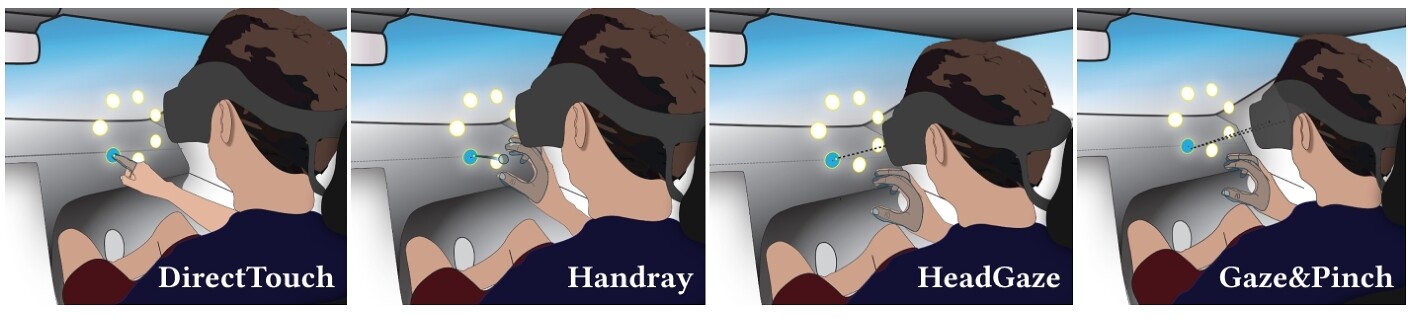
As the use of Head-Mounted Displays in moving vehicles increases, passengers can immerse themselves in visual experiences independent of their physical environment. However, interaction methods are susceptible to physical motion, leading to input errors and reduced task performance. This work investigates the impact of G-forces, vibrations, and unpredictable maneuvers on 3D interaction methods. We conducted a field study with 24 participants in both stationary and moving vehicles to examine the effects of vehicle motion on four interaction methods: (1) Gaze&Pinch, (2) DirectTouch, (3) Handray, and (4) HeadGaze. Participants performed selections in a Fitts’ Law task. Our findings reveal a significant effect of vehicle motion on interaction accuracy and duration across the tested combinations of Interaction Method × Road Type × Curve Type. We found a significant impact of movement on throughput, error rate, and perceived workload. Finally, we propose future research considerations and recommendations on interaction methods during vehicle movement.